
Best Place For Wildebeest Migration In East Africa
January through March is the Calving Season in Tanzania’s Serengeti National Park.
Calving seasons start when ungulates return to Serengeti National Park from Masai Mara National Park, which occurs between November and December. This is when many pregnant moms are there. As the newborns get older, the more than 1 million more angulates that are born exert strain on the available pasture.
Due to various circumstances, many herd members are lost along the journey, necessitating the replacement of the departed friends with a new generation. In the Masai Mara National Reserve, where zebras, gazelles, wildebeest, and impalas spend the last months of the year, many babies are born. Before returning to Serengeti National Park in November or December, the majority of wild animals enter Kenya between late July and October.
Infants are born between January and March, particularly in Tanzania’s Ndutu area. Adding to already enormous numbers are more than a million more calves for gazelles, zebras, impalas, and wildebeest.
Some wild animals seek richer pastures in later months, particularly when the rains begin, as a result of increased feeding demand on the limited pasture over time.
While in Serengeti National Park, from April to mid-June |Wildebeest Migration in East Africa
There is a shortage of food in Southern Serengeti National Park as a result of the additional ungulates joining the already enormous population. Infants are old enough to eat enormous amounts of grass by April or May. Some of the zebras begin to go northward in case the rains begin to fall elsewhere as forecast.
Since the calves’ limbs are still weak, their speed is quite sluggish. In the center of Serengeti National Park, the vast swarm of wildebeests, gazelles, impalas, and zebras stops in the Seronera region.
Tanzania is now going through its slow travel season. You could have the pack to yourself and very few other people outside the national park employees, because the Serengeti National Park sees fewer visitors and less traffic from cars. Because of the slow economy at this time of year, lodging establishments may provide reduced rates.
Search for young-adult wildebeest that are being introduced into their circle of life by senior ungulates and learning to follow in the level plains of Serengeti National Park.
Impalas, zebras, gazelles, wildebeests, kobs, and many more are anticipated to feed towards the western corridor of Serengeti National Park as the big migration picks up speed. The herd of wildebeest and other animals may eat the luscious grass beside the Grumeti River.
Lions, leopards, hyenas, cheetahs, jackals, and Nile crocodiles are among the predators who now decide what to eat for the day.
The Great Wildebeest Migration Season in Serengeti National Park runs from August to September.
Huge numbers of wildebeests migrate from Tanzania’s Serengeti National Park into Kenya’s Masai Mara National Reserve during the peak months of August and September.
This is the busiest time of year for the Masai Mara National Park’s massive wildebeest migration in Kenya. There is a lot of drama in the river, such as predators being sent away by their victims. For the already worn-out ungulates, it is the last straw between life and death.
On both sides of the Mara River, expect to see sizable visitor crowds eager to see those unique moments of the wildebeests in action. Even with the massive number of cars, having a camera with a good lens allows you to focus in on every aspect of the Great Wildebeest Migration.
The Great Wildebeest Migration season runs from October to November.
The greatest number of ungulates, including zebras, impalas, and wildebeest, have entered the Masai Mara National Reserve during these months. You can see a small number of wildebeest moving from Kenya’s Northern Serengeti National Park into the Masai Mara National Reserve at this time.
Even the show’s stars may be perplexed and heading back to Tanzania, where the predators are less obvious. The huge wildebeest migration usually leaves the Serengeti National Park for a while.
You may witness massive herds of antelopes, gazelles, wildebeest, zebras, and impalas from Kenya’s Masai Mara National Reserve.
The Great Wildebeest Migration in the Masai Mara takes place from November to December.
The Masai Mara National Reserve in Kenya is the focal point of the massive wildebeest migration. Many predators pursue their victims in order to continue feeding. The Masai Mara vegetation is overrun by the growing numbers of impalas, gazelles, and adult wildebeests.
The migratory ungulates may begin their return trip to Northern Serengeti National Park around November or December. The grass may have recovered following the extended absence of wild animals.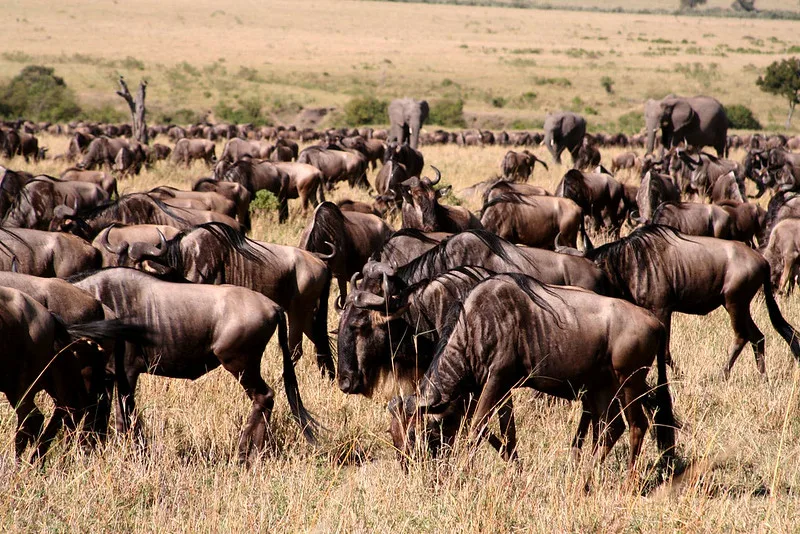
Masai Mara National Reserve is now the center of the massive wildebeest migration. Since the bulk of the wild animals still live on the plains of the Masai Mara National Reserve, most tourists are interested in coming during the holiday season.
If all conditions remain the same, calving may occur once all wildebeests, zebras, impalas, and gazelles have entered Serengeti National Park, which is typically from January to March. Lions, cheetahs, hyenas, and jackals are among the predators that skim in preparation for another meal.
As soon as they are born, the ravenous predator focuses on the still-stumbling calves. For the scavengers who are never content, this is party after party. The wildebeest typically travel among the mob with the new mothers and babies to protect their offspring. Mother ungulates will do everything it takes to protect their young from predation.
Why Reserve a Safari in the Serengeti National Park During the Calving Season to See the Great Wildebeest Migration in East Africa
Because of the many rains that come during the wildebeests’ leaving season, the Serengeti National Park’s normally flat plain area is exquisitely covered in green flora. This is an opportunity for anyone looking for a natural, green setting for a picture session.
A new generation of calves is born, and they are fascinating to observe as they swiftly adapt to jungle life. In addition to sheltering from predators in the grass, the herd is prepared to defend the younger generation by allowing them to roam freely.
Numerous calving sessions that were conceived during the big wildebeest migration take place in February. Because the babies are still stumbling, the animals are usually calmer and move more slowly. During this period, even their next move is more predictable.
This is a great time of year for people on a limited budget to take advantage of reduced rates on domestic flights, lodging, driver guide fees, and other services. Because there are fewer people in the park, there may be a chance to get a modest safari package with a luxury facility at a lower price.
Because there are fewer people and their cars, you could also have the park to yourself. Even if there are fewer opportunities for predator-prey drama, you can still record all of the great momentIn the e Masai Mara National Reserve and the Serengeti National Park, it’s also birding season. Numerous birds may be observed building nests in an attempt to get ready for the breeding season. More than 500 bird species, including international migrants, may be found in Serengeti National Park. 57 raptors and more than 470 other bird species call Kenya’s Masai Mara National Reserve home.
In East Africa, during the Great Wildebeest Migration
The majority of visitors like to go on East Africa safaris between June and September. This is regarded as the busiest time of year for travel. You may film for production stations and shoot beautiful, one-of-a-kind nature photos. This time, there are more unique animadramasms visible, and the wildebeest migration is reaching its height.
During the big Wildebeest migration season, there is a good chance of spotting predators in action. The majority of this occurs quickly.
There are several opportunities to record unique moments, such as the prey protecting itself from the savage predator or the raptors being overpowered by the prey’s strategies. In order to deceive their potential prey, zebras like traveling in a line.
During East Africa’s Slowest Safari Travel Season
The low season of safari offers the opportunity to get up close and personal with wildebeests, gazelles, impalas, and other wildlife, whether in the Serengeti National Park or the Masai Mara National Reserve. Between February and May, the park has less car damage, the big migration is in low gear, and there are fewer animals in the park.
There is a lot of flora for ungulates to eat, and there is lush grass all over. This is the ideal time of year to visit the Masai Mara National Reserve or the Serengeti National Park for a more detailed animal photo setting with a natural backdrop.
The Masai Mara National Reserve and Serengeti National Park provide reasonably priced service amenities. Some lodges renovate in anticipation of the busiest times of the year, lowering their rates to draw in some guests.
Things to Bring for East Africa’s Great Wildebeest Migration | Wildebeest Migration In East Africa
Safari clothing in shades of tan or Khaki
Warm clothing for chilly mornings
For driving in an open safari vehicle, use a safari hat with a larger brim.
Sunscreen protects your skin from the stinging sun, especially while you’re watching games all day.
To shield your eyes from intense sunlight, wear sunglasses.
Toiletries that are either unsuitable for your skin type or not provided by the lodge
Flip-flops and safari boots are appropriate footwear for the wildlife drives.
A lightweight backpack to transport your safari equipment.
A camera with a high-quality lens to record all the unique moments of Africa’s massive wildebeest migration.
A torch for lighting in the event of a power outage. The majority of the lodges are powered by solar energy.
Munching snacks for the game drives
A little amount of actual money to spend on personal purchases, such as souvenirs. Because it takes a long time to withdraw money using credit cards, they are not widely utilized in Africa.
Apply insect repellent to avoid stinging insects that could be buzzing around the park.
A duffel bag is a great way to store your possessions, particularly when you’re traveling long distances and need to connect with several locations. There is a weight restriction even for passengers on domestic flights.
Katland Safaris organizes the best gorilla and wildlife safaris in East Africa. When it comes to gorilla trekking, we will book your gorilla trekking permits for Uganda`s Bwindi and Mgahinga gorilla national park and gorilla permits for Volcanoes National Park in Rwanda. Besides booking your gorilla permit, we will also put all other gorilla safari accessories, like transportation and accommodation, in one package to make your gorilla trekking safari a memorable adventure.
Your gorilla trekking safaris can be customized to meet your safari expectations and needs, and budget. The safari package can range from budget, mid-range, and luxury safaris. Feel free to contact our team of excellent safari consultants to help you organize the best Africa gorilla safari ever.